 AT Labs · Field Reference
Four Rules for LoRa Mesh
in Emergency Management
A field reference for EMA planners, AUXCOMM coordinators, and FEMA communications leaders employing LoRa mesh networks
AT Labs · Field Reference
A field reference for EMA planners, AUXCOMM coordinators, and FEMA communications leaders employing LoRa mesh networks
Preface
LoRa mesh is a distributed radio network where every participating device — called a node — operates as both a radio transceiver and a relay. There is no central server, hub, or base station. When a node transmits, any node within radio range can receive the message and automatically rebroadcast it, extending the effective range of the network well beyond what any single radio could reach. Nodes do not need line-of-sight contact with their destination — messages propagate hop by hop until they arrive. Every device you add to a mesh is also a repeater that expands the coverage picture.
LoRa mesh is a capable and useful tool in the emergency management context. It also gets misapplied often enough that a few clear principles are worth stating directly before any deployment conversation goes further. These four rules are not abstractions — they come from the places where LoRa mesh has been deployed under real conditions, and from the places where it has been deployed wrong.
The goal is not to limit what LoRa mesh can do. The goal is to use it in the situations where it actually performs — and to keep it out of the situations where it will not.
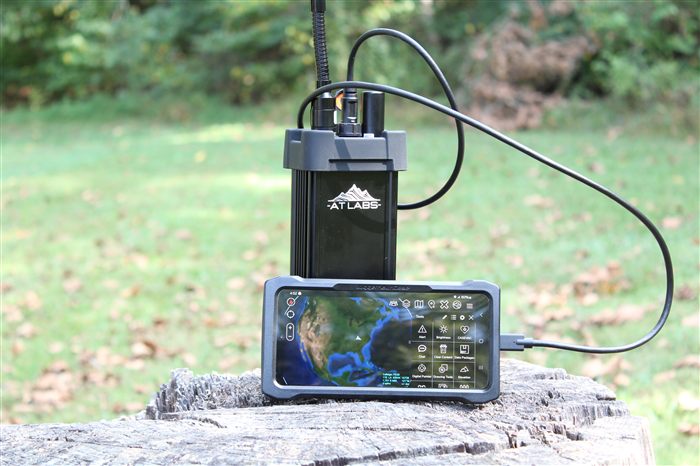
The RM-1 and RM-2 are AT Labs-designed LoRa mesh devices purpose-built for emergency management use. Both run Meshtastic, MeshCore, and Reticulum — the three platforms discussed in this guide. The RM-2 differs from the RM-1 only in transmit power; in every other respect they are the same device. Neither requires supporting infrastructure to operate. They are ready to join or form a mesh the moment they power on. Choosing the right platform for the right operational context is the work this document is designed to support.
Meshtastic is the right platform for incident-scale operations. It is proven, widely deployed, simple to stand up, and its flood routing architecture is an asset at the scale of a single incident with a defined team. The RM-1 and RM-2 — in both portable and infrastructure configurations — serve this environment well. Portable devices go on personnel. Infrastructure nodes go on apparatus light towers, fire towers, elevated structures, or anywhere elevation can be gained quickly. Both serve the same incident mesh. Both make the coverage picture better.
PLI is the primary data type at incident scale. Text messaging is secondary. Keep that priority clear and the mesh performs. Lose track of it and the channel fills with traffic it was never sized to carry.
MeshCore and Reticulum are the right platforms for regional and EOC-scale operations. Their structured routing models handle geographic scale and sustained traffic in ways that flood routing cannot. Infrastructure RM nodes deployed at elevation — solar powered, pole mounted, strategically placed — form the backbone of these regional networks. These are planned networks, not self-organizing ones, and they require the investment in network design and ongoing management that planned infrastructure always requires.
Using Meshtastic where MeshCore belongs produces a congested, unreliable regional network. Using MeshCore where Meshtastic belongs introduces unnecessary complexity into an environment that needs simplicity under pressure. The operational scope determines the platform. Not the other way around.
All three platforms discussed here grew out of open source community projects. That origin matters operationally because robust, volunteer-built mesh networks already exist across much of the United States and beyond. The Meshtastic community mesh covers most populated areas. Regional MeshCore networks like TennMesh span entire states. These networks were built by volunteers, are maintained by volunteers, and serve a genuine community resilience function that exists independent of any agency operation.
That resource comes with a responsibility EMA planners need to understand before they deploy. For everyday emergencies — a standard incident response, a county-level exercise, a routine SAR operation — agency operations should not run on the community mesh. An incident response that puts a dozen RM devices on the Meshtastic default channel, all transmitting PLI at regular intervals, will degrade the mesh for every other user on it.
For catastrophic disasters the calculus changes. When Hurricane Helene hit, the community mesh was already running while agency infrastructure was still standing up or had failed entirely. In those first hours the community mesh was not a resource to protect from agency use — it was a resource to leverage because it was what was available. Using it deliberately, for the specific coordination traffic it could support, while standing up more robust agency infrastructure as fast as conditions allowed, was the right call. The community mesh performed. It bought time.
MeshCore regional networks like TennMesh are not casual hobbyist infrastructure — they are carefully planned regional networks with significant volunteer investment behind them. They are a potential mutual aid asset of real value. Burning them out with inconsiderate traffic is not a way to start that relationship.
The principle is not binary. It is situational: in routine operations, protect the community mesh by staying off it. In catastrophic events, leverage it deliberately and responsibly while building something more capable. Know which situation you are in before you key up.
Every communications plan is built around a PACE framework — Primary, Alternate, Contingency, Emergency. Where LoRa mesh sits in that framework is not a fixed answer. It depends on the incident, the environment, and what other tools are realistically available and functional in that specific operational area.
For most agencies in most environments, LoRa mesh belongs in the Contingency or Emergency tier. It is the tool you reach for when traditional radio systems are not cutting through, when cellular is gone, when your interoperability channels are saturated or out of range. In that role it is exactly what it needs to be — infrastructure-independent, instantly deployable, personnel-accountable, and operational on battery power for days.
Typical placement for most agencies · Terrain-limited AOs may move to P
But some agencies operate in environments where that calculus is inverted before the incident even begins. River canyons, dense vegetation, steep terrain, remote wilderness — these are places where traditional radio fails predictably and cellular was never an option to begin with. Agencies that operate regularly in these environments often find that LoRa mesh moves to the Primary slot not as a last resort but as an honest assessment of what actually works where they work.
LoRa mesh infrastructure is uniquely suited to rapid deployment in exactly these environments. A portable RM device is operational the moment it is powered on. An infrastructure node can be up on a pole or strapped to a tree in minutes. And airborne nodes are changing what rapid deployment means entirely. A small unmanned aerial system with an RM node attached can re-establish mesh connectivity across a significant area in minutes, in terrain that would otherwise require hours of ground work — if it could be covered at all.
The important thing is not where LoRa mesh sits in the template — it is that the PACE plan reflects operational reality rather than institutional preference. If your AO is a river canyon and your primary comms plan depends on a repeater that can't see into it, your PACE plan has a problem that LoRa mesh can solve. Acknowledge that before the incident, not during it.
LoRa mesh does not carry voice. It is not a replacement for traditional radio systems — P25, DMR, VHF, UHF — or the interoperability infrastructure that agencies depend on for life-safety voice coordination. Those systems exist for good reasons and LoRa mesh is not a substitute for them.
What LoRa mesh does is fill the gaps those systems leave — personnel accountability when a team member is separated or incapacitated, text coordination when voice channels are saturated, persistent PLI in areas beyond repeater coverage. It does those things well, on a battery that lasts days, without any supporting infrastructure.
The moment LoRa mesh is positioned as a voice replacement in an operational plan it will fail to meet that expectation, and the legitimate capabilities it does provide will be dismissed along with it. Keep it in its lane. Its lane is useful — and in the right environment, it is the most useful lane on the road.
Those capabilities complement traditional radio rather than compete with it. Both have a role. Neither makes the other unnecessary. The plan that uses both correctly is the plan that works.
Talk with AT Labs about your operational requirements, coverage environment, and how LoRa mesh can complement the communications systems your team already depends on.
Contact AT LabsAT Labs · at-labs.tech · RM-1 and RM-2 available for agency evaluation